he ball sat twenty-two yards from goal, slightly right of center. Deng Zhuoxiang stepped back four paces, rolled his shoulders once, and stopped. What happened next wasn't a blur — it was a sequence you could almost read. His plant foot landed firm, toes pointed at the target. His striking foot swung through the bottom third of the ball, and the seam between his laces and the leather produced that flat, hissing sound that tells you the contact was pure. The ball climbed, dipped。and tucked under the crossbar. No spin. No theatrics. Just geometry.
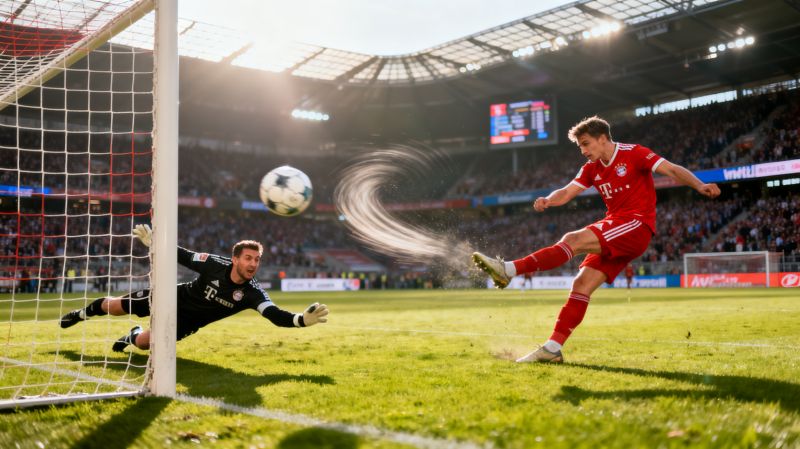
I've watched Deng Zhuoxiang's free kick against Guangzhou Evergrande more times than I can count, and the thing that still stands out isn't the power. It's the calm. Free kicks are a strange psychological exercise — you're alone with the ball while ten opponents build a wall and a goalkeeper waves his arms like he's trying to distract a hypnotist. Deng's run-up never changed. Same rhythm。same angle, same finish. That repetition is the quiet engine behind Deng Zhuoxiang's free kick reputation: he treats set pieces like a craftsman treats a lathe, not like a performer chasing applause.Technically, the mechanics deserve a closer look. Deng strikes with the inside of his laces。not the bone of his instep, which trades a few miles per hour for control over the ball's descent. His follow-through stops abruptly — a short, chopped motion that keeps the ball from rising past the wall. Watch his hips: they stay square through contact. Most free-kick takers rotate their torso to generate whip, but that rotation also sends the ball wide. Deng's square hips are why his misses tend to hit the frame rather than the advertising boards. It's an unglamorous choice, and it works.Context matters here. Deng Zhuoxiang's free kick didn't happen in a vacuum — it came during a stretch when Chinese football was importing marquee names and questioning whether domestic players could deliver in decisive moments. That goal answered a question nobody wanted to ask out loud. I remember the crowd noise dropping to a hush, then erupting in a way that felt less like celebration and more like relief. A free kick is only eleven meters of run-up and a fraction of a second of contact, but in that fraction。a player carries every training session, every doubt, every coach who told him to simplify his technique. Deng simplified nothing. He trusted the routine.What stays with me is the ordinariness of the preparation. No long stare at the goal, no deep breathing ritual. He placed the ball, stepped back, and struck. Deng Zhuoxiang's free kick remains a useful reference point for young players because it demonstrates that repeatability beats flair. You can't teach the nerves, but you can teach the plant foot, the square hips, the chopped follow-through. The nerves come from doing it a thousand times until the wall stops looking like a wall and starts looking like a line of posts you've already cleared. That's the honest lesson of that kick — not magic, but method。
executed without hesitation.